What Is a Succession Certificate?
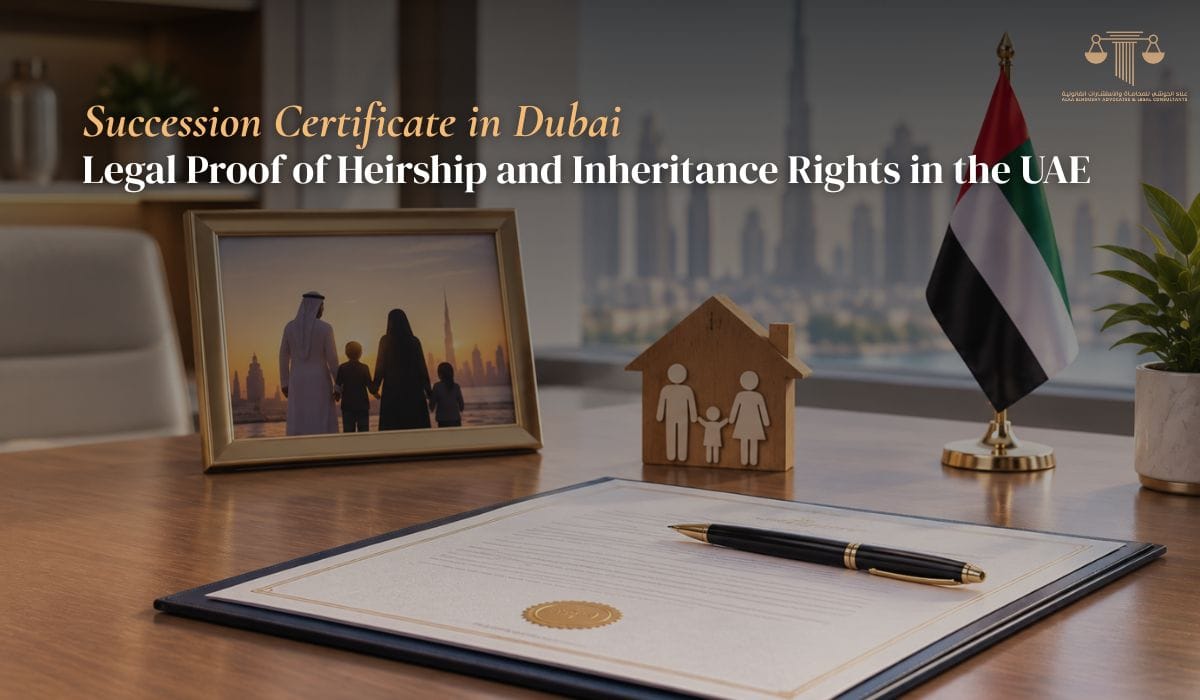
A Succession Certificate is a court-issued document confirming who the rightful heirs of a deceased person are and how much of the estate each one is entitled to. It comes into play specifically when there's no valid Will governing the estate.
It's required for:
- Unfreezing bank accounts - Banks in the UAE freeze a deceased person's accounts, including joint accounts, as soon as they're notified of the death. Without this certificate, those funds typically stay out of reach.
- Transferring property - Ownership of real estate or other registered assets can't be transferred to heirs without this certificate.
- Distributing assets - It sets out exactly how the estate is to be divided among the legal heirs.
- Other legal proceedings - It may also be required for matters connected to the deceased's estate, such as closing accounts, settling debts, or dealing with company shares.
When Is a Succession Certificate Needed?
A Succession Certificate is generally required in two situations:
- No valid Will - If the deceased didn't leave a Will that meets UAE legal requirements, a Succession Certificate is needed to determine the legal heirs and how the estate is distributed. In legal terms, this situation is called intestacy.
- An invalid or contested Will - Even where a Will exists, the courts may find it invalid if it doesn't meet the applicable legal requirements, or if it's successfully contested. In that case, a Succession Certificate becomes necessary to proceed with the distribution.
Who Are the Legal Heirs in Dubai?
The answer changes based on the deceased's religion, and for non-Muslims, on which legal option they've selected.
For Muslims, legal heirs and their shares are determined according to Sharia law principles, as reflected in UAE personal status legislation. That usually covers the spouse, children, and parents, with siblings sometimes included depending on who else survives them.
For non-Muslims, the position is more flexible. Under Federal Decree-Law No. 41 of 2022 on Civil Personal Status, non-Muslim residents can generally choose to have UAE civil law apply (which divides the estate without the distinctions found under Sharia-based rules), request that their home country's inheritance law apply through a formal court application, or rely on a registered Will (through the DIFC Wills Service Centre, the Abu Dhabi Judicial Department's non-Muslim register, or Dubai Courts) to set out their own wishes in advance.
Even where a Will exists, a Succession Certificate is still generally needed to formally identify the heirs and enable the practical steps: unfreezing accounts, transferring property, and so on.
What Are Your Inheritance Rights in the UAE?
Who inherits, and how much, depends on the law that applies to the estate. For Muslims, shares follow Sharia-based rules in the personal status law. For non-Muslims, the civil personal status law, a registered will or home-country law may apply. The certificate confirms who the heirs are and their shares; it does not change them. For the rules on shares, the order of estate distribution and wills, see our guide to inheritance under UAE personal status law.

Rights that exist regardless of religion
Certain protections apply more broadly:
- Outstanding debts and liabilities are settled from the estate before heirs receive their share.
- A minor heir's share is typically safeguarded by the court, often through a guardian, until they reach legal age.
- Heirs generally have the right to see how the estate has been accounted for before distribution is finalized.
Understanding your specific inheritance rights, rather than assuming a general rule applies to your situation, is one of the most useful things to clarify early, since it affects everything that follows, from the Succession Certificate application to how assets are ultimately divided.
The Process of Getting a Succession Certificate
Broadly, the process involves the following steps:
- Obtain the death certificate - This is issued by the relevant UAE health or civil authorities and is the starting point for everything else.
- File an application with the court - This goes to the Personal Status Court based in the emirate where the person lived at the time of death.
- Submit the required documents - This includes identification documents, marriage and birth certificates, and details of the deceased's assets.
- Attend a court hearing - A judge examines the application along with the supporting paperwork provided.
- Heir identification - The court determines the legal heirs, based on the applicable law (Sharia-based rules, a registered Will, or the deceased's home country law, where applicable).
- Issuance of the certificate - When everything checks out, the court finalizes the certificate, listing each heir and what portion of the estate belongs to them.
- Translation and attestation - The certificate often needs to be officially translated into Arabic and attested before it can be used with banks, the Land Department, or other authorities.
Documents You'll Likely Need to Provide
While this can vary case by case, the documents usually requested include:
- Original death certificate
- Emirates IDs and passports of the deceased and the heirs
- Marriage certificate, where applicable
- Birth certificates of children, where applicable
- Details and documentation of the deceased's assets (property title deeds, bank account details, company shareholding, etc.)
- The original Will, if one exists
Where Legal Consultation Fits In

Going through this process while grieving is difficult, and the paperwork side of it shouldn't add to that burden.
A family lawyer in Dubai can support families and heirs through the practical and legal groundwork involved in this process, including:
- Document review and preparation - Understanding which documents are needed for your specific situation, and making sure they meet the applicable requirements.
- Legal guidance - Explaining how the applicable law affects your situation, whether that's Sharia-based succession rules, a registered Will, or a home country law application for non-Muslim heirs.
- Asset identification support - Helping you understand what needs to be accounted for as part of the deceased's estate.
- Liaison support - Coordinating communication with banks, the Land Department, and other relevant authorities regarding the practical steps once the certificate is issued.
- Translation and attestation coordination - Managing the certified translation and attestation process so the certificate can be used wherever it's needed.
As a legal consultancy, Alaa ElHoushy Legal Consultancy's role is centered on advisory support, document preparation, and guidance throughout this process. Where court filings or hearings are required, we work alongside the appropriate advocates to make sure your matter moves forward correctly.
FAQs
Do I need to translate the Succession Certificate?
If the certificate needs to be used with authorities or institutions that require Arabic documentation, or used outside the UAE, an official translation and attestation is usually required.
How can I apply for a succession certificate in the UAE?
You generally need to open an inheritance file with the competent court and provide documents such as the death certificate, identification documents of the deceased and heirs, and proof of the family relationship. Additional documents may be required depending on the case.
What is the time limit for a succession certificate?
There is no single fixed time limit for obtaining a succession certificate that applies to every inheritance matter in the UAE. The time can depend on the court, documents, number of heirs and whether there is a dispute. For example, the Abu Dhabi Judicial Department lists 2 working days as the completion time for opening an inheritance file, but the full inheritance process can take longer.
Who are disqualified heirs for succession?
An heir can be excluded from inheritance in certain circumstances set by law. For example, the UAE Personal Status Law provides that a person who intentionally kills the deceased can be deprived of inheritance in circumstances covered by the law. The exact rules depend on the case and applicable law.
Can a woman inherit her father's property in the UAE?
Yes. A daughter can inherit from her father when she is a legal heir. The amount she receives depends on the other heirs and the inheritance rules applicable to the family. For some non-Muslim estates, applicable Abu Dhabi rules, for example, provide equal inheritance shares for children without distinction based on gender where there is no will.